
"741 Hz"
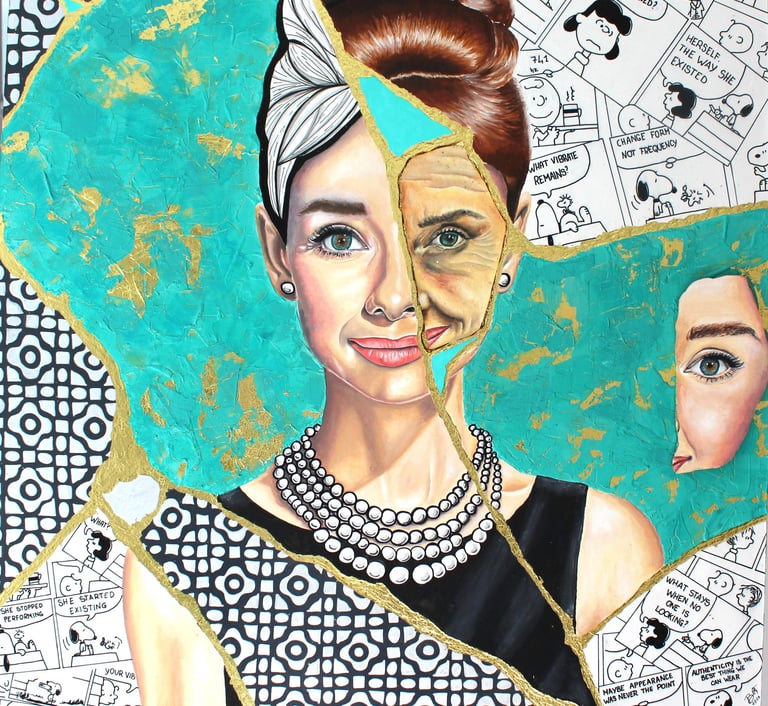
The viewer is invited to participate symbolically in the passage of time, moving aside what the world sees in order to reveal what time itself cannot erase.
Through this movable fragment, the artwork becomes more than an image; it becomes an experience. And it is precisely at that moment that the most important question emerges: Who are we when nobody is watching?
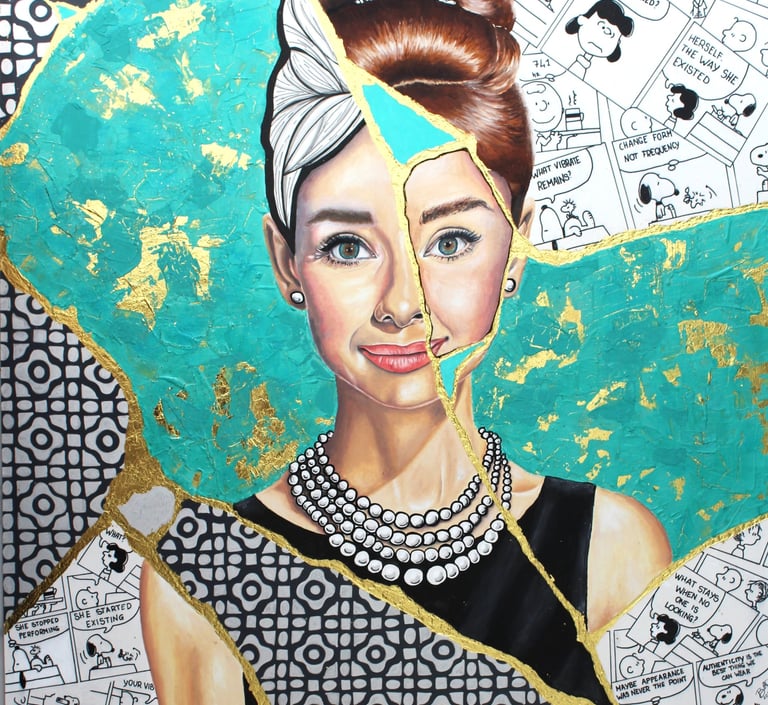
The piece originates from a slab of marmorino that was intentionally broken and subsequently reassembled. The fracture is enhanced with gold, reflecting the idea that, at times, it is necessary to break the form we believe ourselves to be in order to rediscover the more authentic one we truly feel within.
The crack thus becomes the symbol of a passage from self-representation to authentic being.
The 741-hertz vibrations, translated visually through cymatics and artistically reinterpreted, represent the search for authenticity not as a theoretical concept, but as a lived, felt, and transformative experience.
The use of comic-style elements is equally intentional and almost provocative. Through their simplified drawings and concise language—reminiscent of childhood expression—they unexpectedly confront us with profound and complex questions that often resist clear answers.
Who are we when nobody is watching? When there are no roles to perform, no approval to seek, no judgments to fear? When time removes the image the world has constructed of us? Who are we when only our true selves remain?
Despite its contemporary, modern, and seemingly immediate visual language, the vibrations and the fracture invite the viewer to do the opposite: to slow down, to reflect, to look beyond the image, and to reconnect with the deepest part of oneself—a part not defined by roles, expectations, or labels, and one that we ultimately choose to carry with us until the very end.
Medium and features:
mixed media on reconstructed casting plaster.
interactive magnetic element, gold facture, cymatic interpretation.
Dimensions: 80x80 cm.

What remains when no one is looking?
Few women have embodied beauty and elegance as completely as Audrey Hepburn. Yet this artwork is not about the kind of beauty that belongs to appearance.
It speaks instead of a deeper form of beauty—the one that remains when we no longer need to be seen, but simply to be.
Here, Audrey Hepburn becomes a universal metaphor. On one side, she represents the woman on stage, beneath the spotlight, recognized by the world as an icon. On the other, she represents what remains when the lights fade, the curtain falls, and the passage of time carries away expectations, roles, approval, and labels—when we are left alone with ourselves.
The artwork also includes an interactive element that transforms the concept into an experience. A fragment of the young Audrey's face can be removed and repositioned within the piece. This gesture reveals a second image: an older Audrey, intentionally placed in a deeper and less immediately visible layer of the composition.